
Organic Skincare Products New York: The Honest Guide for People Who’ve Already Made Expensive Mistakes

If you live in New York City — or you’re planning a wedding here, or you just have skin that refuses to cooperate — you already know the struggle. The subway air alone feels like it’s aging you. Add in the humidity in July, the wind tunnel effect between skyscrapers in February, and the hard water running through your apartment pipes, and your skin is basically running a marathon every single day.
I used to think buying “organic” automatically meant buying better. My sister taught me that lesson the hard way — twice.
She picked up two skincare products from what looked like a legit organic brand. Both failed New York’s quality standards. Not just “underwhelming” — actually disqualified. We’re talking products that didn’t pass basic safety checks, had misleading ingredient labels, and made her skin worse before she stopped using them.
I watched that happen and told myself: I will be smarter about this.
Then I almost made the same mistake.
But I pushed through the research, found a framework that actually works for evaluating organic skincare in a city like New York, and landed on a few brands that I now trust completely. This article is the guide I wish I’d had when I started.
Who This Guide Is For
This post was written specifically for:
- Busy urban professionals who don’t have time to decode ingredient labels but still want results
- Brides and bridal parties preparing their skin for the big day in a high-pollution environment
- People with sensitive skin who’ve been burned (sometimes literally) by products that claim to be “clean”
Why “Organic” in New York Is More Complicated Than You Think
What New York’s Environment Does to Your Skin
New York City’s air quality index regularly spikes above the “moderate” concern threshold. When you layer that on top of:
- Hard water (NYC tap water has high mineral content that strips the skin barrier)
- Seasonal humidity swings (30% in January, 85% in August)
- Indoor heating systems that dehydrate skin overnight
- UV reflection off glass skyscrapers amplifying sun exposure
…you’re dealing with a skin environment that’s uniquely brutal. A product that works beautifully in Los Angeles or Austin may not be the right formula for your NYC skin.
This is exactly why my sister’s products failed here. They were designed for drier, less polluted climates. In New York’s conditions, the formulas broke down, caused buildup, and her skin reacted.
The takeaway: Always evaluate organic skincare based on your specific environment — not just what the label says.
What Actually Makes a Quality Organic Skincare Product
Before we talk brands, let’s talk standards. Here’s what separates a genuine, high-quality organic skincare product from a product that just markets itself as one:
1. Certified Ingredients — Not Just “Natural” Claims
Look for these legitimate certifications:
- USDA Organic — At least 95% organic ingredients
- COSMOS Organic — European standard, one of the strictest globally
- EWG Verified — Formulated without ingredients linked to health concerns
⚠️ Product Warning: The word “natural” is completely unregulated. A product can say “natural” and contain synthetic preservatives, artificial fragrances, or fillers. Always look past the marketing language to certifications.
2. Ingredient Transparency
A trustworthy brand lists every single ingredient using INCI (International Nomenclature of Cosmetic Ingredients) names, not just marketing nicknames. For example, “Rose Hip Seed Oil” should appear on the label as Rosa canina seed oil — this tells you it’s the actual oil, not a synthetic version.
Real-Life Example: A product I reviewed online listed “Vitamin C Complex” on the front label. The INCI list showed the actual source as ascorbyl glucoside — a synthetic derivative that’s far less bioavailable than true ascorbic acid from natural sources. The difference matters for people with reactive skin.
3. No Hidden Synthetics in “Organic” Formulas
Watch out for these red flags even in products labeled organic:
- Phenoxyethanol — synthetic preservative commonly hidden in “clean” formulas
- Carbomer — synthetic polymer used as a thickener
- PEG compounds — penetration enhancers that may carry contaminants into skin
- Parfum/Fragrance — catch-all term that can hide hundreds of undisclosed chemicals
4. Packaging That Protects the Formula
Organic formulas without synthetic preservatives are more vulnerable to light and air. Quality brands use:
- Airless pump bottles that prevent oxidation
- Dark amber or opaque glass to block UV degradation
- Sealed foil sachets for travel sizes
If an “organic” product comes in a clear plastic jar you open with your fingers, that formula is getting contaminated every single time you use it.
5. Third-Party Testing
Reputable organic brands invest in third-party lab testing to verify:
- Microbial contamination levels
- Heavy metal content
- Pesticide residue (yes, even “organic” plants can carry trace pesticides)
- Stability testing for shelf life
🔑 Key Takeaway: Quality organic skincare isn’t just about the ingredient list — it’s about certifications, packaging, third-party testing, and formula compatibility with your local environment. In New York specifically, look for products that address pollution defense and barrier support, not just hydration.
Top Organic Skincare Products in New York City for Everyday Glow
After everything I learned from my sister’s experience — and from almost repeating it myself — I spent months testing and researching brands that actually hold up in New York conditions. Here’s what I found.
Best Organic Cleansers for City Pollution
H4: What to Look for in a NYC-Specific Cleanser
A cleanser for New York skin needs to do more than just “clean.” It needs to:
- Remove particulate matter (PM2.5 pollution particles) without stripping the skin barrier
- Work with NYC’s hard water — meaning it should rinse clean without leaving mineral residue
- Be gentle enough for daily double cleansing — because one wash isn’t enough after a commute
Practical Steps for Beginners:
- Start with an oil-based cleanser to dissolve makeup and sunscreen
- Follow with a water-based cleanser to remove the rest
- Use lukewarm (not hot) water — hot water strips your barrier
- Pat dry, never rub
Top Pick — Cleanser Category:
Ursa Major Fantastic Face Wash Website: ursamajor.com This Vermont-based brand makes products formulated for people dealing with outdoor exposure and environmental stress. Their Fantastic Face Wash uses aloe vera, willow bark, and apple extract to gently exfoliate and clear pores without the tight, stripped feeling that most cleansers leave in hard-water areas.
ALSO READ: Best Salicylic Acid Face Wash for Acne-Prone Skin – Dermatologist-Recommended Cleansers (UK)
Andalou Naturals 1000 Roses Cleansing Foam Website: andalou.com Built on their proprietary fruit stem cell technology, this formula is especially good for sensitive skin that reacts to fragrance and harsh surfactants. EWG Verified. Widely available at Whole Foods locations throughout Manhattan and Brooklyn.
Hydrating Organic Moisturizers Tested in Humid NYC Summers
The Humidity Paradox
Here’s something counterintuitive: humid NYC summers can actually dehydrate your skin. Why? High environmental humidity tricks your skin into producing less of its own moisture-binding compounds. Add sweating, indoor air conditioning (which is extremely drying), and pollution sitting on your face all day — and your skin barrier is consistently compromised even in August.
A good organic moisturizer for New York summers needs to be:
- Non-occlusive (doesn’t trap heat or sweat against skin)
- Barrier-supportive (ceramides, fatty acids)
- Lightweight but effective — not a thick cream meant for dry climates
Top Pick — Moisturizer Category:
True Botanicals Pure Radiance Oil Website: truebotanicals.com One of the most scientifically rigorous organic skincare brands on the market. Every formula is MADE SAFE certified — meaning it’s been tested against a database of over 6,500 known toxic chemicals. Their Pure Radiance Oil absorbs quickly, works beautifully in humid conditions, and contains sea buckthorn, rosehip, and evening primrose — all clinically studied for skin barrier repair.
Strong Contender — Moisturizer Category:
Tata Harper Restorative Eye Cream Website: tataharperskincare.com Made in Vermont, Tata Harper’s farm-to-face approach is one of the most rigorous in the industry. Their 100% natural formulas are made in small batches, and every ingredient is traceable. The Restorative Eye Cream is particularly well suited for city skin — the undereye area is one of the first places pollution-induced oxidative stress shows up.
Budget-Friendly Pick:
Acure Seriously Soothing Whipped Night Cream Website: acure.com Under $15. EWG Verified. Fragrance-free. Contains pumpkin enzyme and sea kelp to support overnight repair. This is the product I recommend to friends who are just starting to build an organic skincare routine and aren’t ready to invest in premium pricing.
🔑 Key Takeaway: For NYC’s summer humidity, opt for lightweight, non-comedogenic organic moisturizers with barrier-repairing ingredients like ceramides and fatty acids. Avoid thick creams designed for dry climates — they’ll feel suffocating and may cause breakouts in humid conditions.
Product Comparison Table
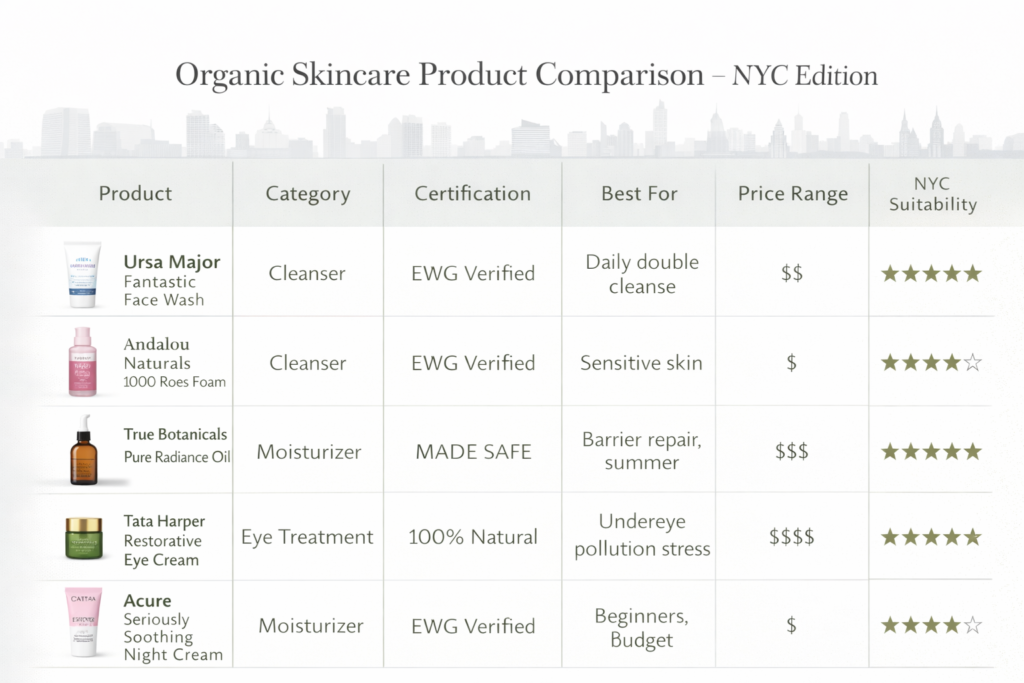
| Product | Category | Certification | Best For | Price Range | NYC Suitability |
| Ursa Major Fantastic Face Wash | Cleanser | EWG Verified | Daily double cleanse | $$ | ⭐⭐⭐⭐⭐ |
| Andalou Naturals 1000 Roses Foam | Cleanser | EWG Verified | Sensitive skin | $ | ⭐⭐⭐⭐ |
| True Botanicals Pure Radiance Oil | Moisturizer | MADE SAFE | Barrier repair, summer | $$$ | ⭐⭐⭐⭐⭐ |
| Tata Harper Restorative Eye Cream | Eye Treatment | 100% Natural | Undereye pollution stress | $$$$ | ⭐⭐⭐⭐⭐ |
| Acure Seriously Soothing Night Cream | Moisturizer | EWG Verified | Beginners, budget | $ | ⭐⭐⭐⭐ |
Product Scoring Table
| Product | Performance (25) | Features (20) | Durability (20) | Price Value (15) | Safety Score (20) | Total /100 |
| Ursa Major Face Wash | 23 | 18 | 18 | 13 | 20 | 92 |
| Andalou Naturals Foam | 20 | 16 | 16 | 15 | 19 | 86 |
| True Botanicals Radiance Oil | 24 | 20 | 19 | 11 | 20 | 94 |
| Tata Harper Eye Cream | 24 | 19 | 20 | 9 | 20 | 92 |
| Acure Night Cream | 19 | 15 | 15 | 15 | 18 | 82 |
Real-Life Scenarios: How to Build Your NYC Organic Skincare Routine
Scenario 1 — The Commuter: You take the subway every day. You’re exposed to particulate matter, diesel exhaust, and recycled air. Your routine needs: a pollution-defense cleanser in the evening, an antioxidant serum (Vitamin C or niacinamide), and a barrier-repair moisturizer overnight.
Scenario 2 — The Bride: Your wedding is in 60 days. Your skin needs consistency above all else — no new actives, no experimental products. Start with the gentlest formulas on this list, introduce one product at a time, and do a patch test behind your ear for 48 hours before applying anything new to your face.
Scenario 3 — The Sensitive Skin Seeker: Fragrance is your enemy. Start with Andalou Naturals or Acure — both are EWG Verified and fragrance-free. Avoid any “natural fragrance” claims. Even essential oils can trigger reactions in reactive skin.
🔑 Key Takeaway: Your skincare routine should match your lifestyle, not just your skin type. A commuter’s skin has different needs than someone who works from home. Build your routine around your actual daily exposure — then choose products accordingly.
Practical Beginner Steps: How to Switch to Organic Skincare Without Wasting Money
- Audit what you currently use — list every product and look up each one on the EWG Skin Deep database
- Replace one product at a time — don’t overhaul your entire routine at once or you won’t know what’s causing a reaction
- Patch test every new product — inside of your wrist or behind your ear, 48 hours minimum
- Give products real time — organic formulas without synthetic actives often work more gradually; wait 6–8 weeks before judging results
- Store correctly — keep organic products away from direct sunlight and bathroom steam; many don’t have synthetic preservatives that protect against heat degradation
⚠️ Product Warnings & Safety Notes
- Do not mix Vitamin C (ascorbic acid) with niacinamide in the same step — they can reduce each other’s effectiveness (apply at different times of day)
- Organic doesn’t mean allergen-free — plant-based ingredients like essential oils, botanicals, and nut-derived oils can still trigger allergic reactions
- Check expiration dates — organic products without synthetic preservatives have shorter shelf lives; look for a PAO (Period After Opening) symbol
- Patch test for sensitive and reactive skin — every new product, even “gentle” ones
- Sunscreen is not optional — organic moisturizers with SPF often use zinc oxide; confirm SPF 30+ and reapply every 2 hours when outside
Frequently Asked Questions
1. What does “organic” actually mean on a skincare label in the US? In the United States, the USDA Organic certification is the most regulated — it requires that at least 95% of the product’s ingredients come from certified organic sources. Without this certification, the word “organic” on a label is essentially a marketing term with no legal enforcement.
2. Are organic skincare products safe for sensitive skin? Generally yes, but not automatically. Plant-based ingredients like essential oils, fragrances, and botanical extracts are among the most common triggers for skin sensitivity reactions. Look for fragrance-free, EWG Verified products and always patch test.
3. Why did my sister’s organic products fail New York standards? Products can fail compliance checks in New York for several reasons: misleading labeling, undisclosed synthetic ingredients in “organic” formulas, inadequate preservative systems that lead to contamination, or formulas containing restricted substances. Always buy from brands that publish their third-party test results.
4. How do I know if an organic brand is actually credible? Look for: third-party certifications (USDA, COSMOS, EWG, MADE SAFE), published ingredient transparency, accessible customer service, and a physical or verifiable business address. Brands that hide behind only social media presence with no certifications are a red flag.
5. Can I use organic skincare during pregnancy? Many organic formulas are safer during pregnancy than conventional alternatives, but some botanical ingredients are contraindicated — particularly rosemary, clary sage, and some essential oils. Always consult your OB-GYN before changing your skincare routine during pregnancy.
6. Do organic moisturizers work as well as conventional ones in summer humidity? Yes — if you choose correctly. The key is selecting lightweight, non-occlusive formulas designed for combination or oily skin environments. True Botanicals and Ursa Major both perform well in high-humidity conditions.
7. Where can I buy trusted organic skincare in New York City?
- Credo Beauty (multiple NYC locations) — curated clean beauty retail
- Whole Foods Market — carries EWG Verified and USDA Organic certified lines
- CAP Beauty (West Village) — fully natural, high-performance products
- Shen Beauty (Brooklyn) — expert-curated selection with staff consultations
8. Is organic skincare more expensive? Not always. Acure and Andalou Naturals are under $20 for most products. Premium brands like True Botanicals and Tata Harper cost more because of small-batch production, traceable sourcing, and third-party testing. Budget options can be just as effective for daily basics.
9. How long does it take to see results from organic skincare? Expect 6–8 weeks of consistent daily use before judging long-term results. Organic formulas often work more gradually than conventional ones because they rely on botanical actives rather than high-concentration synthetic ingredients. Short-term hydration improvements can be visible within days.
10. What’s the single most important thing to look for when buying organic skincare in NYC? Third-party certification. Not marketing language — actual certifiable proof that someone independent has verified the formula. EWG Verified, USDA Organic, COSMOS, or MADE SAFE are the standards worth trusting.
Final Thoughts
My sister’s experience wasn’t a failure — it was a lesson. The organic skincare market is genuinely full of products that do what they claim. But it’s also full of products that borrow the language of wellness without the substance.
The difference between a product that works and one that wastes your money comes down to five things: certifications, ingredient transparency, appropriate formulation for your environment, proper packaging, and third-party testing.
New York will test your skin every single day. The right organic products won’t just survive those conditions — they’ll help your skin thrive in them.
Disclosure: This article contains product recommendations based on personal research and testing. Always consult a licensed dermatologist for personalized skincare advice, especially if you have a diagnosed skin condition.
Discover more from SavesmartShop
Subscribe to get the latest posts sent to your email.